Mastery Enters the Fray!
The Combat and Progression Update introduces the revised Adventuring Mastery System.
Players who have followed Pantheon’s pre-alpha development will remember the early version of Mastery. That version was disabled to help us focus on core class abilities and baseline balance. The upcoming implementation of Mastery is fundamentally different in its approach and scope.
The History of Mastery
The original Mastery System was intended to create a path for players to unlock their character’s full potential over time. It allowed players to incrementally improve their abilities, with each ability having three upgrades that could be purchased with Mastery points. In that implementation, players could eventually gain enough Mastery points to fully upgrade all of their abilities.
While this original design was fun for many players, it resulted in several of the ability upgrades feeling weak and/or redundant. Over time, it proved to be the wrong approach: we needed a Mastery system where your decisions have the potential to result in a different outcome than someone else playing the same class.
Essentially, the “everyone can unlock their full potential” led to the outcome of “every Warrior is exactly the same.” Thus, the flames to forge a new Mastery system that allowed for personalization and specialization were stoked.
So, let’s begin with a fresh definition: Mastery in Pantheon allows players to shape their character, either broadly or with a specialized focus, to personalize their class within a defined role or to enable their preferred playstyle.
The Shape of Mastery
Each class will have access to two Mastery arrays:
- The first array will focus on the role and playstyle of the class. Think of this as the “thematic” array.
- The second array will focus on the core components of the class. Think of this as the “tools” array.
Note that the names of the arrays are not yet final. The arrays are categories, or buckets. Where the real action happens is in the branches inside each array. Let’s take a look at the Playstyle or “Thematic” array for the Warrior.
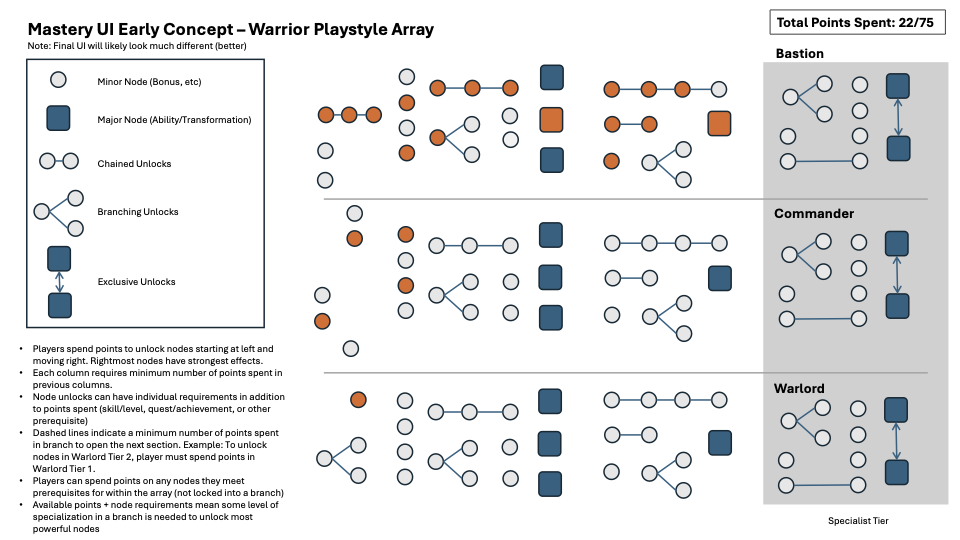
(Note: This is a concept illustration. It is not meant to perfectly represent the Mastery UI in its final form.)
What kind of Warrior do you want to be? When you chose the Warrior, what was the power fantasy you imagined growing into with the class?
- Perhaps it was the quintessential super-tank: A solid wall of steel soaking massive damage, wielding a massive shield and standing at the front lines of battle. In that case, you would invest heavily in the Bastion branch.
- Perhaps it was the battlefield strategist: High mobility and positional superiority, skillfully rescuing allies while wielding a deep arsenal of shouts, formations and banners. In that case, you would invest heavily in the Commander branch.
- Perhaps it was the blood-soaked weapons master: Forsaking the confines of a protector, leveraging your extensive battle experience and weapons expertise to cleave and bloody your enemies. In that case, you would invest heavily in the Warlord branch.
This “thematic” array focuses on broad gameplay styles within a class, such as the Bastion, Commander, and Warlord branches for Warrior. While it is currently possible to lean into one of these directions through different ability loadouts, Mastery allows for a much higher degree of playstyle specialization and boosts effectiveness within that playstyle.
The “tools” array focuses on some of the specific tools and ability types available to your class, such as Banners, War Cries, and Formations for the Warrior. This means that even if you and another Warrior choose the same branch in the “thematic” array, your choices of what to emphasize in the “tools” array may be very different. The goal here is to provide a variety of potential Mastery builds that you can experiment with over the lifetime of your character.
Earning Mastery Points
As you adventure throughout Terminus, you will acquire Mastery Points as you level up your character. However, Mastery is intended to be both a vertical and horizontal progression system, which means there are additional ways to acquire Mastery Points outside of leveling up. For example:
- In-game accomplishments/achievements via exploration, taking down a challenging enemy for the first time, and so on.
- Quest Rewards.
- Extremely rare loot drops or items gained through very high faction standing.
Progressing Through a Mastery Branch
Each Mastery Array has three branches as illustrated by the concept above. As you accumulate Mastery Points, you will be able to spend them in either of the two Mastery Arrays. There will be a maximum number of points that can be spent within each array. For example, in our current concept you can spend a total of 75 points in the “thematic” array and a total of 75 points in the “tools” array. These point totals not yet final.
Mastery Points are used to unlock nodes within a branch, and each node grants a benefit of some sort. A node may have a minor effect, such as a passive character bonus, a unique modifier to an ability, a skill cap increase, or an attribute point. Some nodes will have major effects, such as completely transforming how some of your abilities work, or granting new abilities altogether.
You will be free to spend points broadly across the different branches. The maximum number of points you will be able to spend is limited. To get the most powerful mastery unlocks, you will be forced to make choices in terms of which aspects of your class you want to emphasize, and which ones you want to leave at their base level of effectiveness. For example, if you decide you want to specialize in Banners for your Warrior, you will find that you are more limited in how far you can progress in the branches for Formations or War Cries.
In addition to spending Mastery Points, you may need to meet other prerequisites to unlock some nodes. In many cases, your skills will play a critical role in how far you can advance in a branch. Deeper sections of the branch will not unlock until you have achieved a minimum level in a particular skill. Aside from skill, some nodes will require you to have other nodes in the branch unlocked first. In addition, some very powerful nodes may have other requirements, such as completing an activity in-game before you can unlock them. The goal is for the decisions that you make in spending your Mastery points to feel weighty and earned.
Interacting with Mastery
Our current plan is for the Mastery UI window to unlock at level 5. We will be refining our plans for the UI and how it is displayed to players as we progress with development of the system.
We are planning to provide a way for players to reset their Mastery Points in game so that they can try different combinations and experiment with different builds. There will be limitations on this functionality: players will have to visit specific NPCs to do the reset, and while the first time will be free, there will be a cost to pay for additional resets beyond the first. This cost will scale based on how many Mastery Points are being reset.
Our goal is for Mastery to be an engaging and deeply customizable system that is useful and fun to invest in at all levels of gameplay. Even low-level characters should see a tangible benefit from spending Mastery Points. When combined with the changes we are making to skills, we believe that Mastery will provide a robust vertical and horizontal character progression system that will add depth throughout your character’s journey.
Tomorrow, we will talk about the new system for Crafting and Gathering Progression, which will leverage a similar system to Mastery to support the idea of specializing within different Crafting or Gathering Professions.
Discuss this article on the New Official Pantheon Subreddit
Join the Official Pantheon Discord
More from the Combat & Progression Update Details Series
Part One: Overview
Part Two: Unified NPC Templates
Part Three: Combat Formula Adjustments
Part Four: Kill Credit & NPC Spawning
Part Five: Leveling & Experience Progression Adjustments
Part Six: Skills & the Evolution of Techniques
Part Eight: Crafting & Gathering
Part Nine: Itemization, Economy & Roadmap