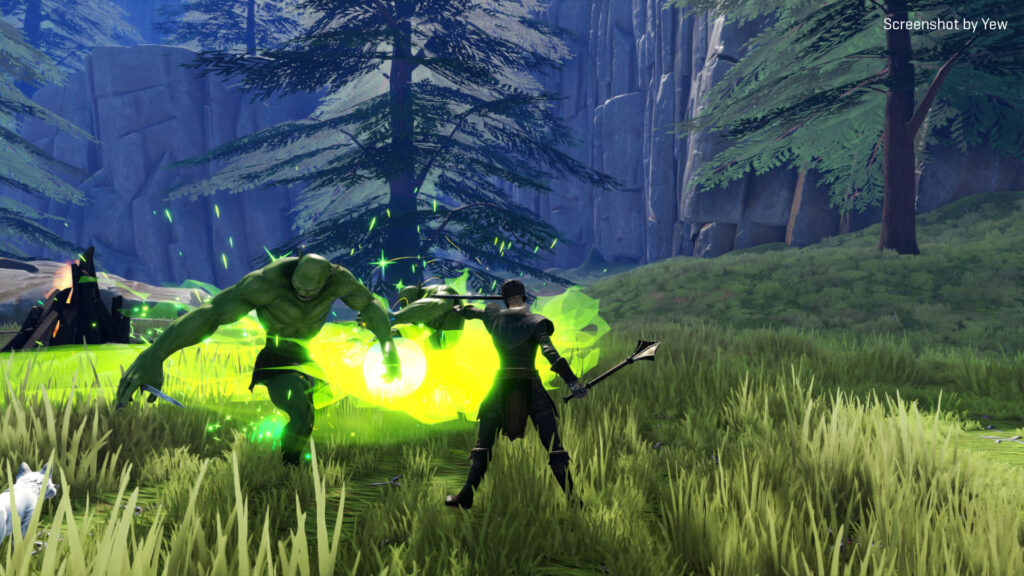
To set the stage for the upcoming combat and character progression updates, we will begin with the most fundamental change: removing the solo vs. group distinction for our NPCs. Let’s start with a little history.
The History of Chevrons
In our desire to create content that could pose a significant challenge to groups, we have experimented with several approaches over the course of development. Our earliest attempts pushed the difficulty of individual NPCs to the point where every NPC, from the least to the greatest, needed at least a mid-sized group to engage. At this point in time, essentially everything in the game was a “chevron” NPC. Did you get aggro from that wolf or bear or rat while running through AVP by yourself? …/corpse
It was a great time for groups during this early era, but we had pushed Pantheon beyond being group-centric into being a group-only game. And something that needs to be said loud and clear is this: Pantheon was never envisioned as a group-only game. Part of the magic in the early MMORPGs that so heavily inspire us was the relative freedom to set out either as a full group of adventurers or to carve a path alone.
We needed a way to get back to a place where both solo and full-group play was viable, without being trivial for full groups. It needed to be a solution that would hold up during heavy iteration and work with the extremely limited content that was available at that time. To accomplish this, we first developed a system of NPC templates to govern an NPC’s health, armor mitigation, resistance values and many other combat characteristics by grouping them into templates based on their class and entity type that scaled with their level. But on top of these categorical, scaling templates, we created a difficulty tier value to function as a smart multiplier on the stats within the template, significantly increasing the health, armor, damage output, etc. of an NPC that had an increased difficulty tier. We slapped a chevron symbol on the nameplate of NPCs with this difficulty tier enabled as a visual indicator to players that those NPCs were built differently, requiring a group to handle. And thus, “chevrons” were born. Over time we have expanded on this concept of difficulty tiers to create additional categories of NPCs: swarmers, pets, major bosses, raid bosses and more.
Chevrons served us very well for a while. Chevrons allowed us to quickly get the game to a point where full groups could be adequately challenged without crushing solo players and small groups game-wide in the process. The data we collected over these past years since the introduction of chevrons allowed us to find points of tuning for both group and solo content at the same time, all of which has set the stage for the upcoming changes.
Why Are We Removing Chevrons?
Since we began talking about the impending removal of chevrons earlier this year, the community has been consistently asking two very natural questions: “Why?” and “How?” First, the why. It would be difficult to quantify how much feedback exists, urging us to remove chevrons. There was even a change.org petition created and the Discord thread where this petition was introduced and discussed ranks as one of our largest Discord topics in history.
The question we had to ask is this: if Pantheon is a group-centric game, and we know our community is counting on us to build a social, group-centric game capable of achieving that challenge and tension we have always intended, why are they so dissatisfied with the way it currently works? Chevron NPCs provide ample challenge for full groups, while solo NPCs offer an alternative. What’s the issue here?
To begin answering this question, I want to share some quotes from our community before we announced this upcoming change.
- “Right now they have two games: a 6-man group/raid-based dungeon game, and a solo game that are completely separated.”
- “It just sets up this line in the sand and kinda kills the fun of seeing what you can do.”
- “While I do enjoy the game, or even the difficulty at times, that part [chevrons] makes it a lot less interesting. It is a very rigid game so far. Little true freedom, something that those old games generally were all about.”
- “The way we’re heading right now is premade groups will have lots of playgrounds and finding people naturally in those areas to group with will not exist.”
There are many more comments that capture this essential message: in creating an effective system to separate and tune solo/duo/trio and group play, we created a hard line where the two could rarely coexist. The result is that most of our dungeons and “group” content areas are only visited by players in full groups. The people that thrive are those in strong guilds or who have a consistent static group. It is rare you will find a duo, or trio, much less a solo player engaging with a dungeon or chevron-filled point of interest. And while it may not be immediately apparent, a line from the petition aptly captures why the presence of solo players and small groups matters in these areas:
“If there were people soloing, or duos/trios in a place like Halnir Cave, it keeps the zone healthy and players can reach out locally to recruit missing classes or backfill a group in order to engage harder content” (like major bosses, more densely packed areas, etc.)
We need to move forward to a place where this healthy, local player interaction can happen within the majority of the game’s content.
One of the most important aspects of classic MMORPGs is the immersive freedom, the lack of harshly defined rails and the way the world opens up more and more as your knowledge of the game and skill with your character increases. The significant and artificial difficulty that chevron NPCs impose has stunted that vision of character progression and a progressively opening world. Therefore, we have a plan to remove chevrons in order to realize this tenet-level goal of ours once more.
What Removing Chevrons Means for Solo Players and Small Groups
Once we remove chevrons (the added difficulty tier value), all NPCs, except for named/rares (e.g. Uzhead the Rife), major bosses (e.g. Gnashura the Uncounted Prince), and multi-group targets (e.g. Tel’Daedras), will inherently use the same stats based on their class and level. This means that whether you encounter a shambling skeleton in Thronefast, a Gadai bandit in Avendyr’s Pass, an Ultheran disciple in Halnir Cave, or an Ashbreather Smoke Knight in the Enclave… if the NPC is at or below your level and you have the means to face it alone, there’s a chance you’ll be successful. Named/rare NPCs will be slightly more challenging than normal NPCs but still fall within a category of being soloable/small-group friendly under the right conditions. The chance of success against these targets increases or decreases based on a few factors:
- Level Range – Soloing a level 5 NPC when you’re level 6 will be a very different experience than trying to solo a level 40 NPC when you’re level 41. Expect NPCs to be a bit more challenging the higher level they are, commensurate with your growing knowledge, skill, ability arsenal and gear.
- Player Skill – As is already the case in Pantheon, any class in the hands of a skilled player will be capable of doing more incredible feats.
- Class Choice – While every class in Pantheon will have the potential to solo, some will be more effective and efficient at it than others.
We are planning on increasing the overall challenge of solo content in the game (compared to the difficulty of the current solo NPCs), but also relaxing some diminishing returns effects and giving classes more tools to engage with content in unique ways. NPC density, positioning and movement patterns will be additional levers we use to make various sections of a dungeon or content area more challenging. This is where duos and small groups can thrive, and where we hope they will be more likely to organically form.
What Removing Chevrons Means for Full Groups
With this increased accessibility into previously full-group-only areas, how are we planning to achieve our goal of creating challenging content for full groups? Let’s break this down so we can then see the sum of the parts.
Instead of throwing a blanket of group-only difficulty onto a dungeon the moment you walk in, we will apply increased difficulty in specific areas and for specific encounters. Let’s use Halnir Cave as an example. After these changes, solo players and small groups will have an easier time exploring and pushing deeper into Halnir Cave. It’s entirely possible that an appropriate level and skilled Necromancer, or a charm-wielding Enchanter, or a well-geared and experienced Rogue could make their way to, and slay, Hssyr the Wretch or Tyrasura the Banebound on their own. It’s more likely a duo or trio of players would be able to pull it off, and even more likely still for a full group.
However, we fully intend for our major boss encounters and boss events (where the best loot will be found) to remain challenging enough to warrant a full group when attempted at the intended level. Staying with Halnir Cave as our example, this would include targets like Harathena, Gnashura, and the Thief of Eternity. Ultimately, these targets and the lairs they live in are examples of the content we will be instancing in the future.
We also have other mechanics we can lean into, beyond NPC density/pathing, when we want to raise the difficulty bar for a specific area or encounter. Some of these include:
- Synergies between different NPCs when they are in combat together.
- NPC traits
- Environmental factors like climate and fractures.
The Role of the Consideration System
When these changes go live, it will be important to /consider NPCs before you engage. Remember, there will no longer be a chevron indicator. The determining factor of how difficult an NPC will be for you is in how much higher or lower level the NPC is compared to yours.
Generally:
- NPCs that /con light yellow to dark orange (1-4 levels above you) are appropriate targets for full groups.
- NPCs that /con dark blue to light yellow are appropriate targets for small groups, duos and certain solo classes.
- NPCs that /con light blue and green are appropriate targets for solo players.
These parameters aren’t intended to be forced or prescriptive, but are a helpful guide to get your bearings once these updates occur.
Lastly, there are several updates coming to improve the rate of experience gain to coincide with these changes and the overall increase in TTK.
In Practical Terms
Without seeing this in action, it may be difficult to know what to expect. As mentioned, we will be opening a Public Test Realm this spring to get everyone’s feedback on these changes and make final adjustments before this update fully releases. Until then, however, here is what to keep in mind:
- The distinction between solo NPCs and group NPCs (the “chevron”) will be going away.
- NPC time-to-kill will increase generally. NPC damage output will likely decrease and become less spikey overall, but a greater emphasis on sustainability and resource management during fights will be introduced. Because the difficulty of each fight is going to increase, we plan on increasing the reward (experience/loot) of each fight to balance it out.
- Every player should still feel like they can make progress solo, but some classes will be able to do so more efficiently than others. Certain classes may have an edge when it comes to the strength of their soloing by virtue of their abilities. Player skill will always play a role.
- More content (including many named NPCs) will be available and players may find it advantageous to team up with others organically if they are out hunting by themselves.
- Challenging areas will have denser populations of NPCs, with some NPCs synergizing with each other, forcing players to adopt creative tactics to win. NPC traits, climates, fractures and more will play a role in the design of the most challenging areas.
- The biggest, baddest boss NPCs and toughest content will still require full groups to handle at their intended level.
In our post tomorrow, we’ll talk about some other changes to combat that will also be coming along with this update. As a reminder, all of this will be made available on a public test realm for feedback before we push it out to the live servers.
Discuss this article on the New Official Pantheon Subreddit
Join the Official Pantheon Discord
More on the Combat & Progression Update Details Series
Part One: Overview
Part Three: Combat Formula Adjustments
Part Four: Kill Credit & NPC Spawning
Part Five: Leveling & Experience Progression
Part Six: Skills & the Evolution of Techniques
Part Seven: Adventuring Mastery
Part Eight: Crafting & Gathering
Part Nine: Itemization, Economy & Roadmap